Comparative analysis of fan coil units, duct units, VRFs, air-cooled heat pumps, and chillers
When choosing an air conditioning system, different devices suit different needs and environments. Fan coil units, duct units, VRF units, modular units, air-cooled heat pumps, and chillers each offer unique advantages. Understanding their working principles and characteristics helps you choose the best solution for various buildings and climates. Next, we will compare these devices to help you make an informed decision.
Fan Coil Unit
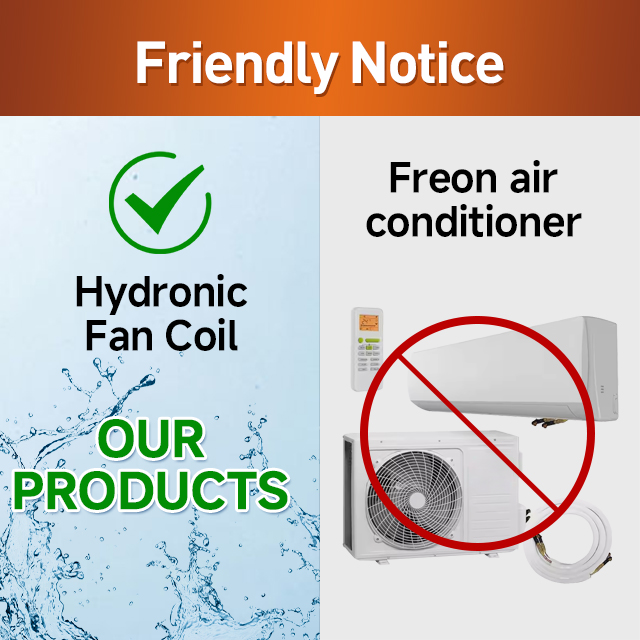
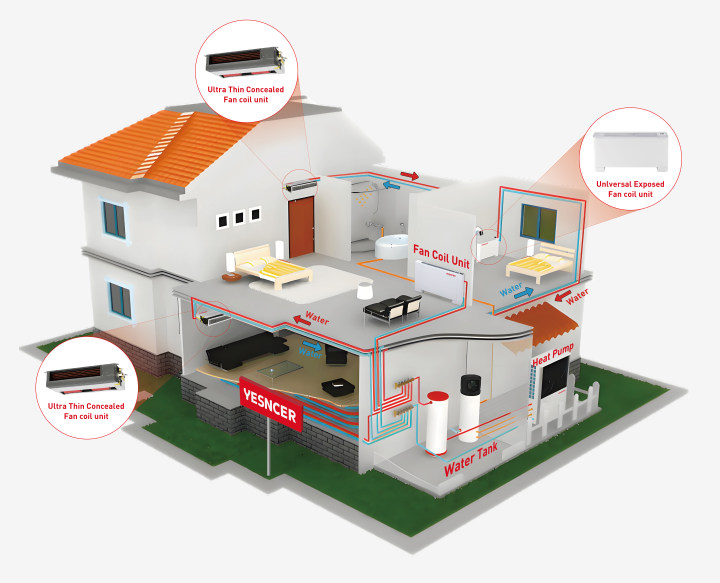
A fan coil unit is a terminal device commonly used in central air conditioning systems. By exchanging cold and hot water, the unit adjusts the indoor temperature. Water serves as the medium, circulating air to regulate both temperature and humidity in the room. This device connects to systems such as chillers, boilers, or air source heat pumps.

Working Principle
The fan coil unit system includes an indoor unit (the fan coil unit) and a water source system (either cold or hot water). Cold or hot water flows through the coil in the indoor unit. This water absorbs or releases heat as it passes through the coil. The fan then circulates the conditioned air into the room. By adjusting the water temperature, you can control the indoor temperature.

Advantages:
- Energy saving and high efficiency: Water circulation heat exchange offers better energy efficiency than traditional air conditioners.
- Independent regulation: You can control each room's temperature for a personalized comfort experience.
- Flexible installation: It supports vertical, horizontal, and embedded installation, adapting to various spaces. Hidden installations save space and improve aesthetics.
- Simple maintenance: It is easy to clean and inspect, helping to extend service life.
Disadvantages:
- Requires external water source: It depends on a cold or hot water system. It needs a water source heat pump or central air conditioning, making system construction more complicated.
- Limited scope of application: It suits small-scale, precise temperature control. Larger areas require multiple indoor units, increasing equipment and maintenance costs.
Duct unit
The full name of duct unit is duct air conditioner or duct air supply air conditioner heat pump unit, which is a central air conditioning terminal device with air as the medium.
Working principle
The duct unit consists of an outdoor unit and an indoor unit. The outdoor unit usually contains an air-cooled condenser and a compressor. After the cooling capacity is produced, it is transported to the indoor unit through a pipeline. The indoor unit is responsible for converting the refrigerant into cold air and distributing it to each room through the air duct.
Advantages
The installation is relatively simple, it can be hidden to save space, and it is convenient to control a small area.
Disadvantages
Each independent area requires a separate outdoor unit, and the energy consumption may be higher than that of a multi-split unit.
Multi-split air conditioner
Multi-split air conditioner is an air conditioning system that connects multiple indoor units through a single refrigerant circuit.
Working principle
The outdoor unit contains one or more compressors, which adjust the refrigerant flow to meet the different needs of each indoor unit. The outdoor unit and the indoor unit are connected by copper pipes, and heat exchange is carried out through direct evaporation of the refrigerant to absorb heat or condense heat to release heat.
Advantages
Energy saving and high efficiency, able to adjust the output according to load changes, one outdoor unit can drive multiple indoor units to operate, saving the space occupied by the outdoor unit.
Disadvantages
High initial investment cost and relatively complex maintenance.
Air-cooled heat pumps
Air-cooled heat pumps provide both heating and cooling services. They change the direction of the refrigeration cycle to achieve winter heating and summer cooling.
Working principle
The outdoor fan forces heat exchange, absorbing or discharging heat from the atmosphere. The refrigerant circulates to release heat to water in the condenser (heating mode) or absorb heat from water in the evaporator (cooling mode). The hot or cold water travels through pipes to the indoor terminals (such as fan coils or floor heating).
Advantages
No cooling tower or water system is needed. Installation is easy, and the system is suitable for areas with water shortages.
Disadvantages
Energy efficiency decreases in low ambient temperatures. Frost may form, requiring a defrost function.
Air-cooled chillers
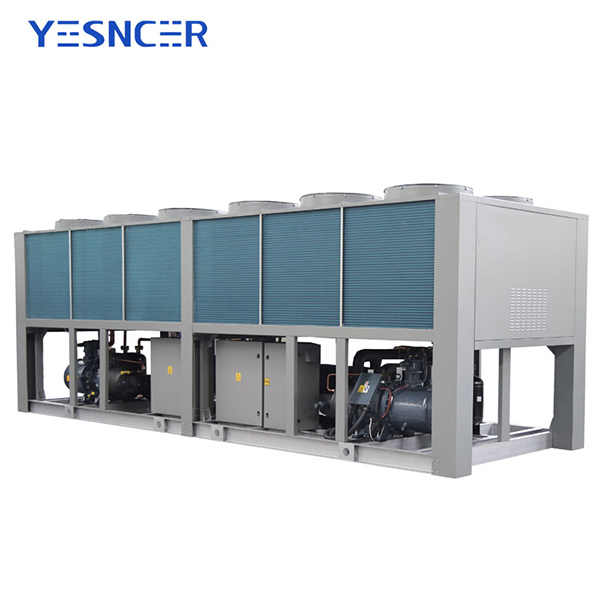
Air-cooled chillers provide chilled water through refrigerant circulation. They use air to cool the condenser, eliminating the need for an external water source or cooling tower. The built-in fan draws in ambient air to cool the condenser fins and remove heat during the refrigeration process.

Working principle
The refrigerant absorbs heat in the evaporator and evaporates. The compressor heats the refrigerant vapor, which then enters the condenser. In the condenser, the refrigerant releases heat to the air blown by the fan. The cooled liquid refrigerant returns to the evaporator to continue absorbing heat.
Advantages
These chillers are easy to install, require no cooling tower or water system, save space and water, and are easy to maintain. They have low water quality requirements.
Disadvantages
Ambient temperature significantly affects their performance. High temperatures reduce cooling efficiency and increase energy consumption. They produce more noise and vibration than water-cooled chillers. Their energy efficiency ratio is lower, leading to higher long-term operating costs.
Water-cooled chillers
Water-cooled chillers use cooling water as the cooling medium for the condenser. They are usually equipped with cooling towers and circulating water pump systems. They are suitable for large buildings or high-temperature environments with abundant water resources.

Working principle
The refrigerant absorbs the heat of the cooling water in the evaporator and evaporates. After passing through the compressor, it becomes a high-temperature and high-pressure gas. It exchanges heat with the cooling water in the condenser. The cooled water is discharged through the cooling tower and recycled.
Advantages
High cooling efficiency, especially stable operation in high-temperature environments, low noise, suitable for noise-sensitive places, high energy efficiency in long-term operation, and may reduce long-term costs.
Disadvantages
Large initial investment, cooling towers and water pumps are required, high water quality requirements, improper handling may cause equipment damage, and limited installation space.
What are the main functional sections of a combined air handling unit?
Things about fan coil installation are worth reading
Related Article
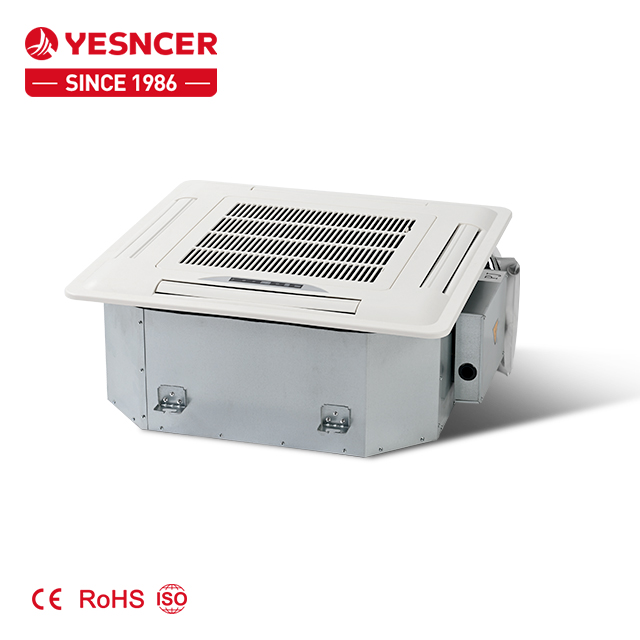
The YESNCER 4-Way Cassette Fan Coil Unit (Model: FP-34 ~ FP-238) is engineered for high-performance air conditioning — ideal for hotels, offices, hospitals, schools, and luxury residential buildings.