Full liquid evaporator vs. dry-type Evaporators
Dry-type and Full liquid evaporators are essential components in refrigeration and air conditioning systems. They both serve the purpose of converting low-pressure refrigerant from liquid to gas, a process that absorbs heat and achieves cooling. We categorize evaporators into these two types based on the flow and positioning of refrigerant relative to the heat exchanger tubes. This article will explore each type’s structure, principles, advantages, and applications, and then provide a comparison to assist in making an informed choice.
Dry-Type Evaporator: Structure and Working Principle
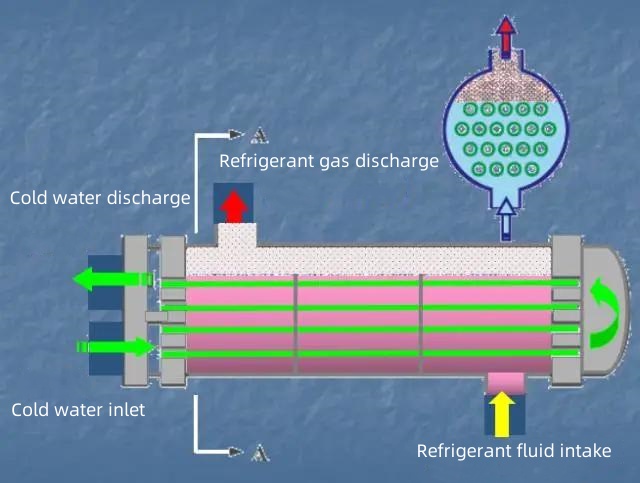
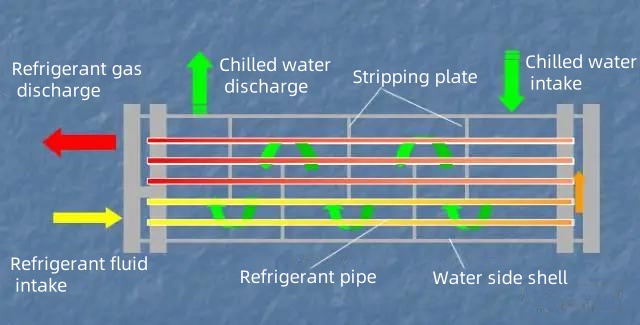
A dry-type evaporator consists of a shell containing multiple heat-exchange tubes. Often, engineers add baffle plates around the tubes to direct water flow, ensuring it spreads evenly across the tube surfaces, which in turn improves heat transfer efficiency. Additionally, a gas separation chamber at the top separates vaporized refrigerant from liquid, so only gas enters the compressor.
Working Process: To begin, refrigerant enters at the bottom in liquid form, where it absorbs heat from the cooling water outside the tubes. As it absorbs heat, the refrigerant gradually evaporates to gas, while its pressure and temperature stay relatively constant. The gas then rises to the evaporator’s top, passing through a separator that removes any remaining liquid droplets before the gas enters the compressor.
Meanwhile, the circulating cooling water continuously removes heat, maintaining the temperature gradient necessary for evaporation. Since dry-type evaporators rely on natural convection, their efficiency is somewhat lower. However, they require far less refrigerant—about a third of what flooded evaporators need. This significantly reduces both operational costs and environmental risks.
Advantages:
- Great Oil Return: Here, lubricant can flow directly back to the compressor with the refrigerant, reducing oil retention issues.
- Low Refrigerant Charge: Dry-type evaporators need only about a third of the refrigerant required by flooded types, which lowers costs and environmental risks.
Disadvantages:
- Lower Heat Transfer Efficiency: Due to its design, a dry-type evaporator’s heat transfer rate is only about twice that of plain tube exchangers, so these systems require larger surfaces for effective cooling.
Applications: Typically, dry-type evaporators suit applications with moderate cooling needs, such as smaller refrigeration units or certain residential AC systems. This makes them ideal for budget-conscious applications where high efficiency is not essential.
Full liquid evaporator: Structure and Working Principle
On the other hand, flooded evaporators are highly efficient heat exchange units, widely used in large refrigeration and air conditioning systems. Their main feature is that cooling water flows inside the heat exchange tubes, while the refrigerant fully submerges the tubes on the outside, where it boils and evaporates to transfer heat effectively.
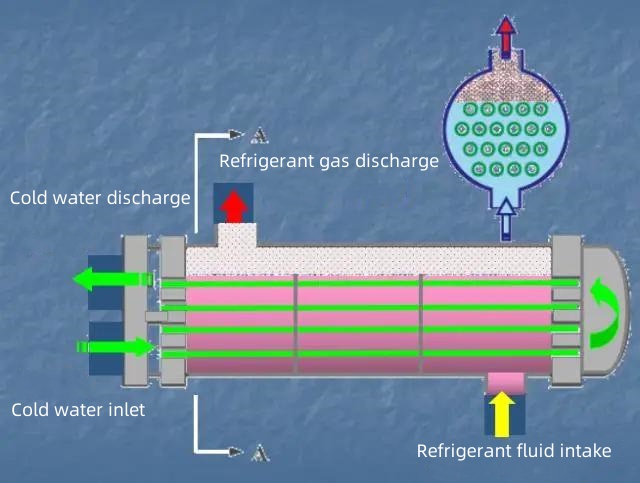
Structural Features: A flooded evaporator includes a sealed shell with high-efficiency tubes arranged in parallel. These tubes may have smooth surfaces or special internal structures (like helical ridges) to increase heat transfer efficiency. In some designs, small pores on the tube surface promote refrigerant boiling. Engineers place a liquid supply port at the bottom, along with a gas-liquid separator at the top to ensure only gaseous refrigerant enters the compressor.
Working Process: In a flooded evaporator, cooling water flows inside the tubes, while refrigerant boils and evaporates on the exterior. The cooling water then absorbs heat produced by refrigerant boiling. Heated water exits the evaporator and carries away the heat, achieving effective cooling. To enhance heat transfer on the cooling water side, baffles between tubes create a more complex water path. This setup increases contact area and turbulence, further boosting heat transfer.
Advantages:
- High Heat Transfer Efficiency: Since refrigerant completely surrounds the tubes, the boiling process enables uniform and efficient cooling.
- Ideal for High Cooling Needs: Flooded evaporators are best suited for large systems like industrial cooling and commercial HVAC systems.
Disadvantages:
- High Refrigerant Requirement: Full liquid evaporators need a significant amount of refrigerant, which raises both operational and maintenance costs.
- Higher Equipment Cost: Due to their complex structure, these systems require more expensive manufacturing and increased maintenance.
Applications: As a result, flooded evaporators serve large-scale refrigeration and commercial air conditioning systems that require high cooling capacity and efficient heat transfer.
Comparison Summary: Full liquid vs. Dry-Type Evaporators
| Comparison Metric | Full liquid evaporator | Dry-Type Evaporator |
|---|---|---|
| Structural Feature | Cooling water flows inside tubes; refrigerant fully submerges and evaporates outside | Refrigerant flows inside tubes; cooling water flows outside |
| Heat Transfer Efficiency | High, with complex water flow paths for enhanced cooling | Lower, relies on natural convection and requires larger surface areas |
| Refrigerant Requirement | High | Low |
| Application | Industrial and commercial cooling systems | Small-scale refrigeration, residential AC systems |
| Equipment Cost | High, with higher maintenance needs | Lower, excellent oil return |
| Advantages/Disadvantages | Full liquid offers high efficiency for large applications but needs more refrigerant and maintenance | Dry-type suits small applications, easy maintenance, low cost |
In conclusion, Full liquid and dry-type evaporators each have unique benefits in terms of structure, performance, and application scenarios. Choosing the right evaporator ultimately depends on specific cooling needs, budget, and operating environment. Flooded evaporators are ideal for large-scale systems with high cooling demands, while dry-type evaporators offer a more economical choice for smaller systems prioritizing budget and simplicity.
Choosing the Right Cooling and Heating Equipment
Common Fan Coil Unit Faults and How to Troubleshoot Them
Related Article
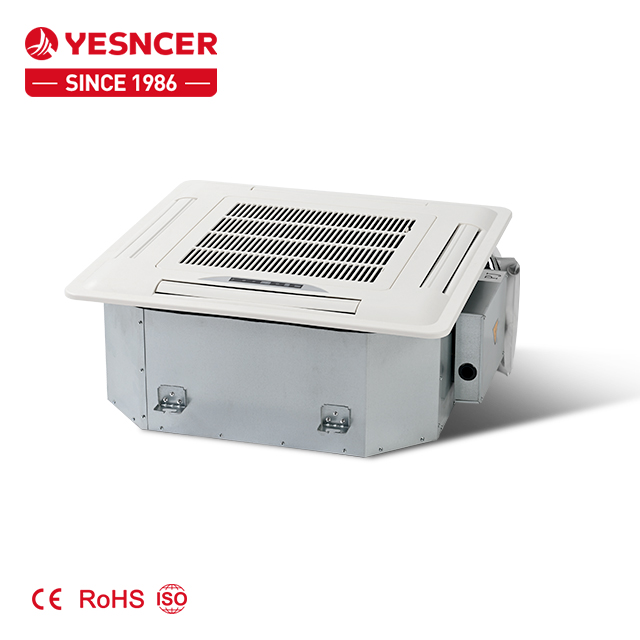
The YESNCER 4-Way Cassette Fan Coil Unit (Model: FP-34 ~ FP-238) is engineered for high-performance air conditioning — ideal for hotels, offices, hospitals, schools, and luxury residential buildings.